Less Hate, More Frank: The Power of the Personal Story
April 27, 2026

April 27, 2026
By Nicole Korsen
The cupcakes were ready and the birthday card was being passed around, hidden under notebooks and behind water bottles. It was slow going though, because every time one of the 25 teachers participating in this human rights seminar raised the pen to add their wishes, they stopped short. No one wanted to miss a minute of Frank’s story.
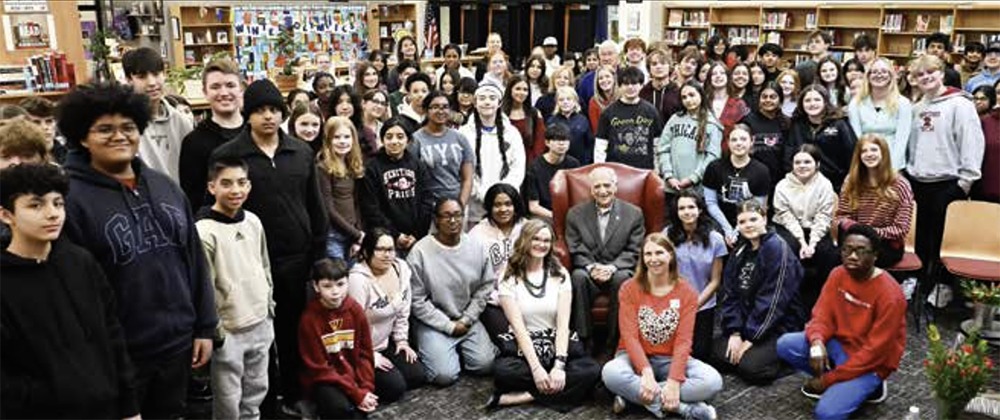
With a remarkably sharp memory, this Holocaust survivor who had just turned 100 (hence the card and cupcakes) was telling the group about his third-grade teacher back in Breslau, Germany. It was 1934. Seven years prior, Frank Cohn’s Uncle Max had been brutally beaten and killed (just for being Jewish, said Frank) by a group of street Nazis, so Frank had grown up with a deep-rooted fear that he didn’t really understand.
This teacher was Frank’s favorite, having looped with his class from second grade, and according to Frank, “I was sure he liked me too.” Then one day, this important role model in Frank’s life came to school wearing full Nazi regalia including a swastika armband. With a sad shake of his head, Frank displayed his third-grade class picture, with this teacher proudly posing among his young students. Frank had circled his own small face so we could tell him apart from his classmates—former friends who, taking the teacher’s lead in being cruel to Frank, had begun chasing him home after school each day. But Frank reassured us that it was okay because he was a fast runner so “they never caught me.” His calm tone conveyed disappointment and loneliness (this outcast Jewish kid was not very popular), but not anger. Frank told us so much more that day—and none of it would have been as impactful if we had just read about his experience. His gratitude was obvious when he recounted his great luck in being able to immigrate to the U.S. with his parents in 1938. His pride overflowed when he told us about joining the Army, becoming a U.S. citizen, and going back to Germany to fight against the same people that had destroyed his world.
We were about to stop him because we worried that he might be tired, but we decided not to. We couldn’t have known that the birthday treat we were about to give him would make his eyes sparkle the way they did when he described the table tennis game where he met his wife. He and his buddy had only known their two female opponents as “ping” and “pong” and with a mischievous grin, Frank told us that he had married pong. I’m not sure he ever even told us her real name, but he lit up when talking about her.
He eventually did need a break from speaking, but after refueling with pizza, the cupcake, and a rousing rendition of “Happy Birthday,” it was clear that he was not going anywhere. Three local Jewish teens had begun our next session, sharing with these mostly non-Jewish teachers about their culture and what it was like to live it as a tiny minority in the DMV area. Frank stayed put—literally, his chair stayed front and center as the teens presented around him—and listened attentively. When they asked him for advice for their generation, he said that our world just needed to “hate less.” That simple saying with Frank’s picture became a sticker (made by a crafty seminar participant) that now adorns many a laptop and water bottle throughout Loudoun County and beyond. It says it all in just four words, “Less hate, MORE Frank.”
The Power of Story
Personal testimony is powerful. Of course, it isn’t every day that you are able to get a speaker like Frank. But you never know until you ask. Being a 2G (second generation/daughter of a Holocaust survivor), I have been fortunate to work in schools that support me in bringing in speakers like Frank and my own father for as long as I’ve been teaching. Before Covid, my high school backed me on an Adopt-a-Survivor* program, where multiple Holocaust survivors would come and speak with small groups of students, who would pledge to “adopt” them by telling their stories every year on Remembrance Days. To this day, when I see students from that program, which ran for three years, they are quick to tell me how they have made those stories their own and never miss a chance to tell them. Holocaust survivors are dwindling every day, but they aren’t the only ones fighting time with a story to tell.
During the seminar with Frank, a different day focused on local African American history. While touring historical landmarks including the Douglass School in Leesburg, which was once Loudoun County’s only Black high school, alum James Roberts joined us. He was a student there in 1968 when the school shut its doors and the black students were sent to the other LCPS high schools. When asked how he felt then, he struggled to answer because “No one had ever asked him that before.” Conversations have a way of surfacing the things we don’t even realize we are hiding. We could have just read the mural on the walls inside Douglass (now a recreation center) to learn about that history. But if we had, we never would have learned how confused and conflicted James was about this move toward equality that felt like anything but that.
Likewise, if I had just printed off my father’s story instead of inviting him into my classrooms, I never would have realized what parts of his story were the most impactful and to whom. I was surprised to learn that the group he resonated with the most was the English Learner population, who connected with his experience of coming to a new country without knowing the language. He would espouse the benefits of staying in school by telling them how he wished he could have done that. But as a 15-year-old immigrant helping his family pay the bills, he had to work just like many of our students. Unlike them however, he was unable to balance both so took himself to the movies to learn English (he sounded a lot like Humprey Bogart) and devoured newspapers and books to fill the gaps in his learning. So it was no surprise when after every session, it was the newcomer students who would shyly crowd around him to talk more.
Finding the right speaker for the right occasion can be tough, but a little outside thinking and networking goes a long way. There are many unique ways to bring a personal perspective to an academic topic. Your students can be a great source with backgrounds and connections that we may not know about. Once during a song analysis unit, a student mentioned that his father’s cousin was a former pop star (Shaun Cassidy!). Sadly, I was unable to make that visit happen. But it doesn’t have to be a big name. Because our students have so little life experience, hearing how people have gotten to where they are is always intriguing to them. Nor does the connection have to be direct. I once watched a man without arms and legs show a gym full of high schoolers how to draw by holding the marker in his mouth. That message was not about art, but resilience and inspiration.
Getting Creative to Get Speakers
We have come a long way towards including a variety of voices into what we teach, but we can go further. Even if an in-person visit is not possible, Zoom is an easy substitute. Many schools offer help in coordinating Zoom calls or in-person visits. TED Talks are also a wonderful way to elevate a voice. Bryan Stevenson, Chimamanda Ngozi Adichie, America Ferrara, and 9/11 “Red Bandana” hero Welles Crowther have all come to life in my classroom. Adichie in particular talks about “The Danger of the Single Story” highlighting the importance of people being seen as more than just one thing. She reminds us that many prejudices come from a singular view of a person, a group, or even a race of people.
One of the best ways to combat hate and antisemitism is to learn about individuals and the unique lives they lead. If we knew less about Frank, he would just be another Jewish Holocaust survivor. But after hearing his story, which was about much more than just what happened during the war, we learned about who he is as a person. As one wise colleague once told me, instead of calling people out, we need to invite them in. It is in the conversations around these stories where curiosity begins and the dialogue happens. Understanding each other on a personal level is the best way to combat othering, bullying, and other detriments to the well-being of our students and selves.
Once the connection and contact are made, there is still the challenge of gaining approval for the visit. In Virginia schools today, teachers are inundated with standards that must be covered, skills that must be mastered, and strict parameters around how to teach any given curriculum. There are parents to answer to and legislators who dictate what can and can’t happen in our classrooms. Bringing in a speaker can be seen as a luxury or even a risk. What topic would I have to skip to fit this in? What uncomfortable truths might they reveal? Considerations like these are necessary to acknowledge in today’s classrooms, but if treated as just obstacles to overcome on the way to deeper student understanding, they can be managed.
It isn’t easy to justify a break in day-to-day routines and methodology, but the rewards can be palpable and lead to a set of different, more important questions. What conversations will they spark? Who will they inspire? What can we learn from a living history? How can we afford to not hear these voices? What positive changes can come from opening up the gates of conversation and understanding? Every teacher in that seminar I mentioned earlier will remember Frank, the person, not just Frank, the Holocaust survivor. His legacy will live on not just because his story will continue to be told, but because he showed us how much can be gained from letting people in.
Nicole Korsen, a member of the Loudoun Education Association, teaches English at Heritage High School and a Regional Seminar Leader for TOLI, the Olga Lengyel Institute for Holocaust and Human Rights.
*View the 10-minute, Regional Emmy Award-winning short film “Journey of Education and Remembrance,” produced by Loudoun County Public Schools, at https://vea.link/TOa.
The average pay of Virginia public school teachers in 2023-24 was $65,830. That is $4,260 below the national average of $70,090.
Learn More